
If your fixed-rate mortgage ends in the next year, you’re probably wondering whether to act now or wait. Here’s where rates stand, what it could mean for your payments, and the steps to take.
This is general information, not mortgage advice. Your home may be repossessed if you do not keep up repayments on your mortgage.
Where rates are now
On 17 September 2026, the Bank of England held the base rate at 3.75%, with six members voting to hold and three voting for a rise to 4%. CPI inflation was 3.1% in the 12 months to August 2026, up from 2.9% in July. The next decision is due on 5 November, a week after the Autumn Budget.
But your fixed rate doesn’t follow the base rate directly. Fixed deals are priced off market expectations, which is why lenders have been raising fixed rates even while the base rate stood still. As of 7 September 2026, average two-year fixes were around 5.63% and five-year fixes around 5.68%, with mainstream best-buy deals roughly in the 4.3% to 4.6% range depending on deposit size.
What it could mean for your payments
If you fixed a few years ago at a low rate, the jump can be significant:
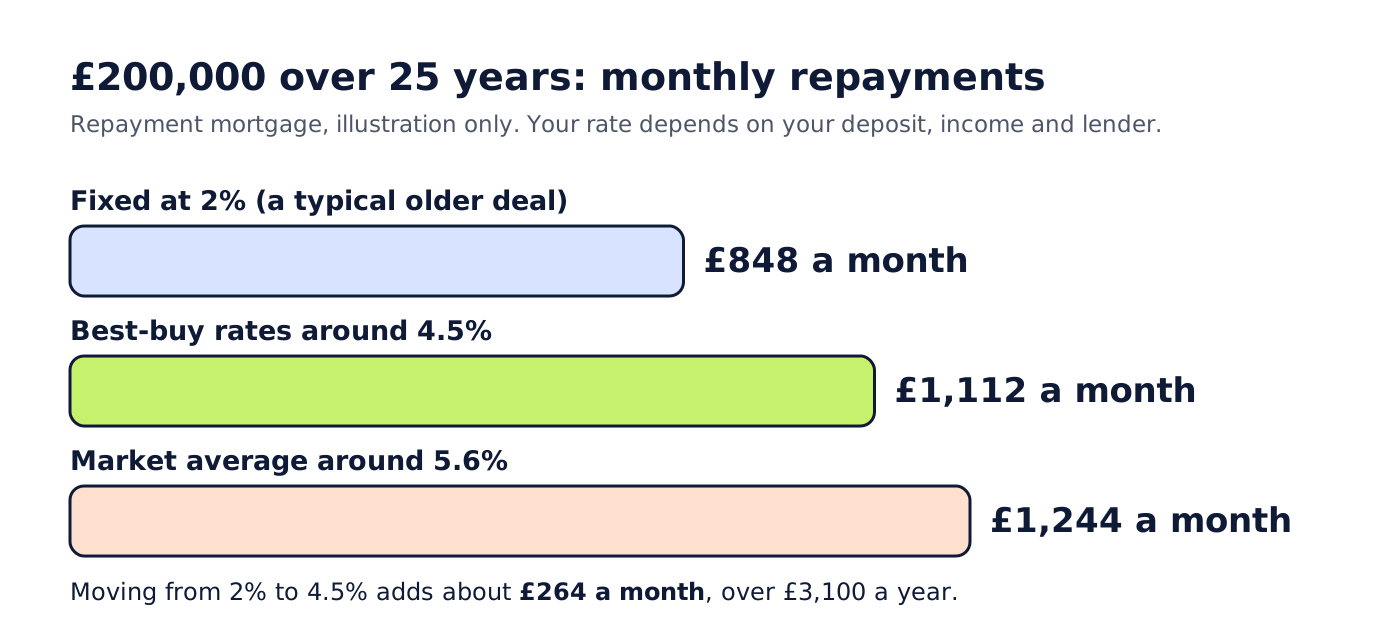
On a £200,000 repayment mortgage over 25 years, moving from 2% to 4.5% adds about £264 a month. Knowing your likely new payment early gives you time to adjust your budget.
What to do, step by step
12 months or more before your deal ends
- Find your end date and any early repayment charges (ERCs) on your mortgage statement or lender app.
- Work out your new likely payment using a mortgage calculator at today’s rates.
- Build a buffer. If your payment will rise, start saving the difference now so it doesn’t come as a shock.
Around 6 months before 4. Get quotes. Ask your current lender about a product transfer and compare with the wider market, ideally through a whole-of-market broker. 5. Secure a deal. Many lenders let you lock in a rate months ahead. If rates fall before your deal starts, you may be able to switch.
In the final months 6. Keep checking. If a better rate appears before completion, ask about switching. 7. Make sure the new deal starts the day the old one ends, so you never slip onto the standard variable rate.
Good to know: A lender’s standard variable rate (SVR) is usually much higher than fixed deals. Drifting onto it for even a few months can cost hundreds of pounds.
Ways to soften a higher payment
- Overpay now while your rate is low, if your deal allows it (often up to 10% a year without penalty). A smaller balance means smaller future payments.
- Consider a longer term to lower monthly payments, but know that you’ll pay more interest overall.
- Review your budget and cut costs elsewhere, such as your energy bill or subscriptions.
- If you’re struggling, speak to your lender early. Lenders must offer support, and free debt advice is available from MoneyHelper and StepChange.
The short version
The base rate is on hold at 3.75%, but fixed mortgage rates have been rising and average around 5.6%, with best buys closer to 4.3% to 4.6%. If your deal ends in the next year, find your end date, estimate your new payment, compare your lender’s offer with the market, and lock in a deal around six months ahead. Above all, don’t drift onto the standard variable rate.
Common questions
How early can I lock in a new mortgage deal?
Many lenders let you secure a new deal several months before your current one ends, often up to six months. Check with your lender or a broker. If rates fall before your deal starts, you may be able to switch to a cheaper one.
Should I stay with my lender or remortgage elsewhere?
Compare both. A 'product transfer' with your current lender is usually quicker, with no new affordability checks in many cases. Remortgaging elsewhere can sometimes be cheaper but takes longer. A whole-of-market broker can compare both.
Fixed or tracker?
A fix gives certainty over your payments; a tracker moves with the base rate, up or down. The right choice depends on your budget and how much uncertainty you can handle.
Should I use a mortgage broker?
A good whole-of-market broker can compare deals across lenders and handle the paperwork. Some charge a fee and some are paid by the lender, so ask upfront.
This article is general information, not personal financial advice. Your situation is your own, so check the details for yourself or speak to a regulated adviser before making big decisions. Where investments are mentioned, their value can go down as well as up.